Overview
Venture: PulmoPath
Industry: Healthcare | Pulmonary Care management
Vision: To shift pulmonary care from reactive, in-person monitoring to a proactive model — using diagnostic and patient data to flag risk early, keep low-risk patients at home, and keep every patient connected to their care team between visits.
The Challenge:
Reactive Care, Invisible Risk
Pulmonary patients have traditionally been managed the same way regardless of risk level — cycling through in-person visits that strain hospital capacity and disrupt patients' lives, even when most of them don't need to be there. Care teams, meanwhile, had no fast way to see which patients actually needed attention.
To solve this, the product needed to:
Surface Risk Instantly: Give a mixed clinical team an immediate read on which patients are trending toward risk, without digging through flat patient lists.
Make Complex Data Legible: Translate dense diagnostic and AI-generated data into something a clinician can interpret in seconds, not minutes.
Keep Patients Engaged: Turn diagnostic data into patient education, so people understand their own health rather than just having it monitored.
Preserve the Relationship: Make the platform feel like an ongoing connection between patient and hospital, not a transactional visit log.
SinanSoft Process
We led full product design end to end — UX and UI — translating a data-dense clinical problem into an interface a care team could use without training.
Designing for the Five-Second Read
The hardest design problem wasn't the interface — it was the information. We built the product around a single test for every screen: does this make complex medical and AI-driven data faster to read, or slower?
Risk-First Triage: Designed high-risk patients to surface visually, turning triage into a scan instead of a search.
Progressive Disclosure: Layered diagnostic depth so clinicians get the quick read first and the full data on demand.
Building the Patient Connection Layer
Reducing hospital visits only works if patients trust the system replacing them. We designed the patient-facing experience as an education tool, not just a data feed — closing the loop between diagnosis and behavior, and giving patients a continuous sense of connection to their care team between visits.
Prototyping in Figma Make
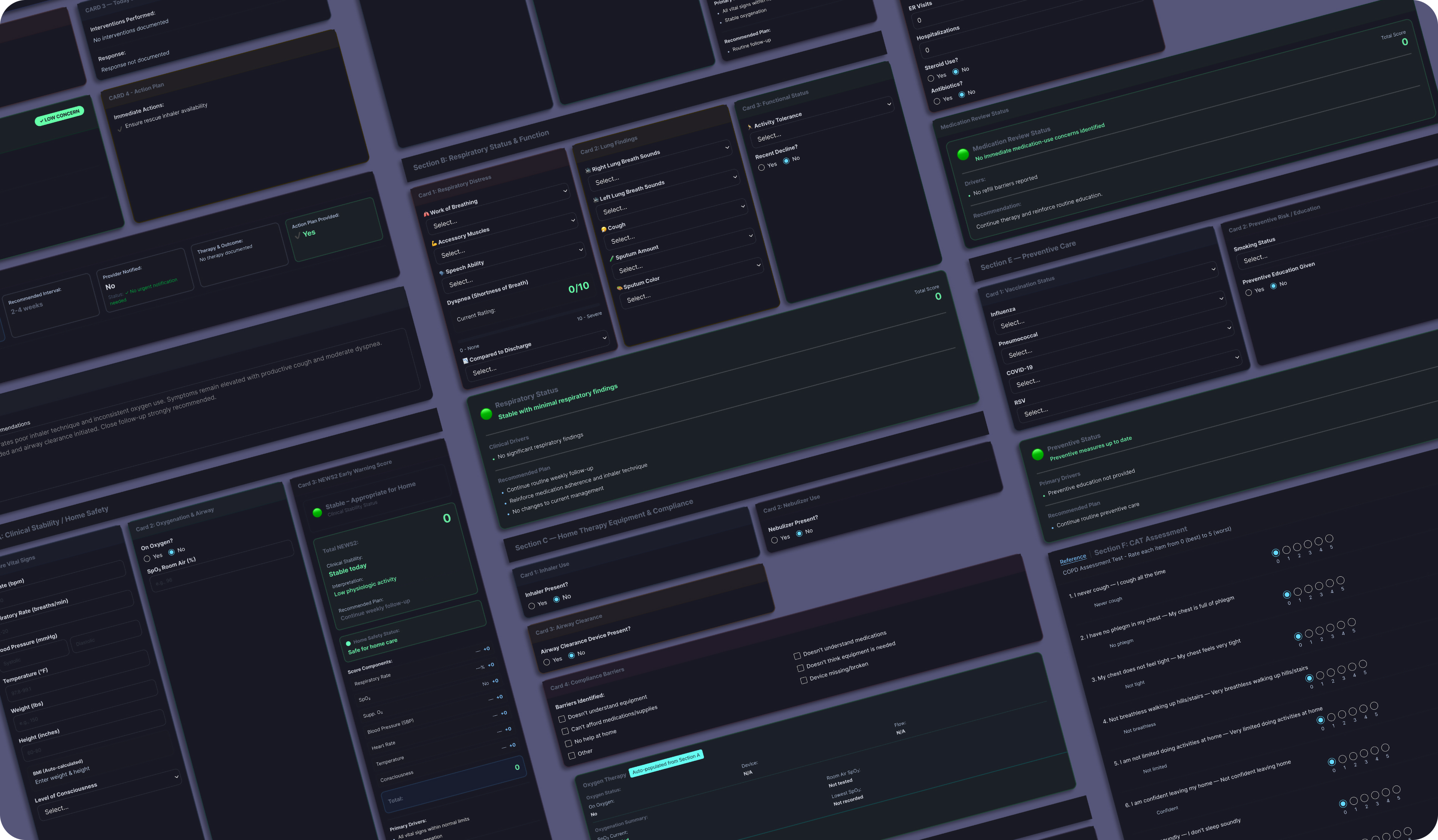
We built a full interactive prototype covering the clinical and patient experience — from login through risk stratification and diagnostic review — so the client could test and validate the flow before development.
Outcome
Status: Interactive prototype complete, covering the full clinical and patient workflow.
Impact: A design system built to support a 60–70% reduction in unnecessary in-person hospital visits, with meaningful cost savings for both patients and the health system.
Asset: A validated UX foundation ready to move into development.
Tech Stack

Figma Make
(interactive prototype)